 Ultimate guide
7 Radio Station Broadcasting History Milestones Explained
Last Updated: November 25, 2026
Quick Summary
Radio station broadcasting history began with electromagnetic theory and wireless telegraphy, then shifted to voice transmission with the vacuum tube, and reached its defining milestone with the first scheduled broadcast in 1920. That 1920 debut moved radio from experimental hobbyist transmissions to licensed stations serving general audiences on a regular schedule.
- James Clerk Maxwell predicted electromagnetic waves in the 1860s; Heinrich Hertz proved them in the late 1880s.
- Lee de Forest's Audion vacuum tube of 1906 made amplification and clear voice transmission possible.
- The first radio broadcast 1920 is most famously associated with station KDKA in Pittsburgh.
- Early stations sold whole sponsored programs before spot advertising spread risk across many advertisers.
- The Public Broadcasting Act of 1967 created the Corporation for Public Broadcasting to fund public stations.
Table of Contents
- How did radio station broadcasting history begin?
- When was the radio invented and who gets the credit?
- The first radio broadcast 1920 and the race to go live
- A history of radio timeline: from crystal sets to digital
- The history of commercial radio and how stations made money
- How a local station operates and serves its community
- Tune in to W1PJM and hear local broadcasting history in action
- Frequently Asked Questions
How did radio station broadcasting history begin?
Radio station broadcasting history began with the discovery that radio waves could carry information through the air, a breakthrough that moved from laboratory theory to practical wireless telegraphy and then to voice transmission. This guide from W1PJM Home Town Radio Station traces that path, from electromagnetic theory to the first scheduled broadcasts and the commercial stations that followed.
The story starts with physics, not entertainment. Nineteenth-century scientists proved that electromagnetic radiation could travel invisibly across distance. Practical inventors then built transmitters and receivers sensitive enough to catch a signal, and once a signal could be caught reliably, someone inevitably wanted to send a voice and music through it. That shift, from dots and dashes to a human voice, is where broadcasting history actually takes shape.
Below, we break down seven milestones that explain how a laboratory curiosity became the broadcast station on your dial.
When was the radio invented and who gets the credit?
Radio was not invented by one person on one date. It emerged from a chain of discoveries, and the credit is genuinely contested among several inventors working across different countries. The honest answer is that radio has no single inventor; it has a sequence of contributors, and which name gets the credit depends on whether you are measuring theory, demonstration, patent priority, or the first practical service.
From electromagnetic theory to wireless telegraphy
The foundational work came from physicists who never built a radio in their lives. In the 1860s, James Clerk Maxwell published equations describing electromagnetic radiation and predicted that waves could travel through space at the speed of light. In the late 1880s, Heinrich Hertz built apparatus that actually generated and detected those waves in a laboratory, proving Maxwell right. That theory gave later inventors the map.
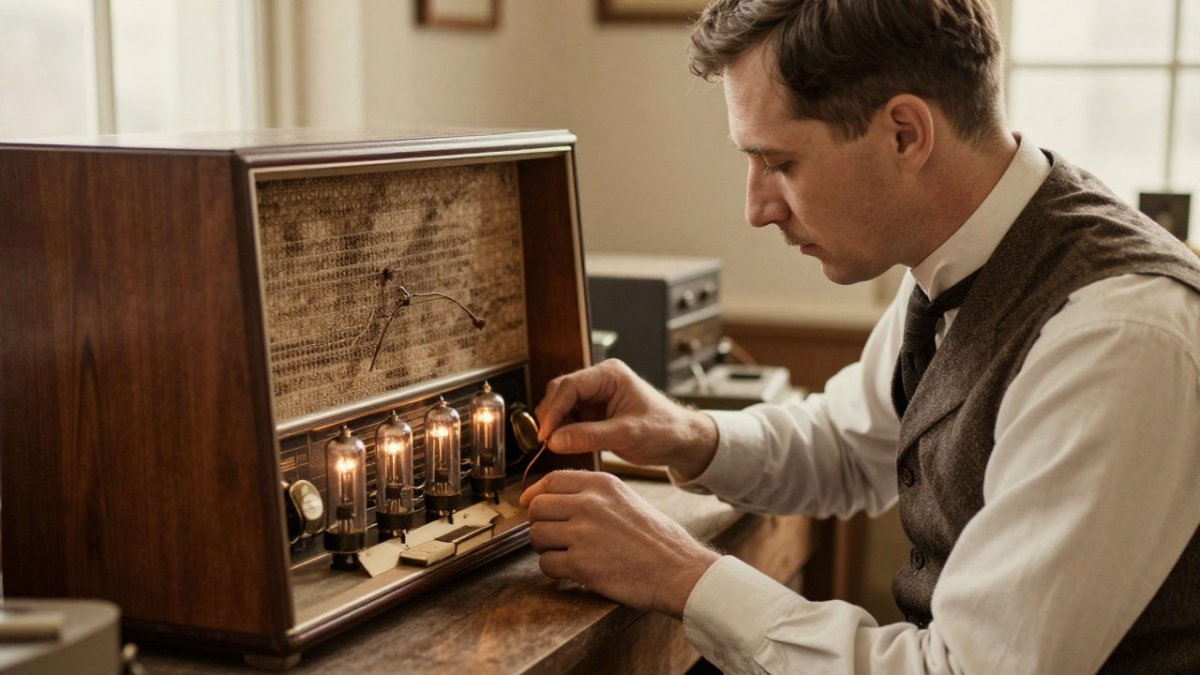
The key mechanical idea was simple: a transmitter creates a rapidly oscillating electrical current, an antenna radiates that energy as waves, and a receiver antenna picks up a faint copy and converts it back into a signal. Early spark-gap transmitters did this crudely, producing a broadband burst that could be heard as a click in a receiver. That was enough for dots and dashes, but not for voice.
The inventors who turned sparks into signals
A cluster of inventors pushed the idea from theory to working equipment, and the dates matter because they explain the priority disputes.
- Heinrich Hertz demonstrated electromagnetic waves in the laboratory in the late 1880s, establishing that radio waves were real and measurable.
- Nikola Tesla demonstrated wireless energy transfer and filed key radio patents in the late 1890s and early 1900s; his work became central to the legal fight over priority.
- Guglielmo Marconi built practical wireless telegraphy systems and is often credited with the first transatlantic wireless transmission in 1901, sending a signal from England to Newfoundland.
- Reginald Fessenden advanced continuous-wave transmission and is associated with early voice and music transmissions around 1906, moving radio beyond dots and dashes.
- Lee de Forest invented the Audion vacuum tube in 1906, which made amplification and clearer voice transmission possible and became the technical backbone of early broadcasting.
The vacuum tube is the breakthrough most timelines underweight. Before it, receivers were passive and weak; after it, a signal could be amplified, tuned, and carried reliably into a listener's home. That single component is what made scheduled broadcasting practical rather than experimental.
A common mistake is assuming a single "inventor of radio" exists. In practice, radio communication is a stack of breakthroughs, and the credit depends on which part of the stack you are measuring. Marconi gets credit for practical long-distance service, Tesla for foundational patents, Hertz for proof of the waves, Fessenden for voice, and de Forest for the amplifier that made broadcasting a mass medium.
Watch out: treating any one inventor as the sole father of radio will get the history wrong and invite correction from readers who know the patent record.
The first radio broadcast 1920 and the race to go live
The first radio broadcast 1920 refers to the debut of regular, scheduled programming aimed at a general audience, most famously associated with station KDKA in Pittsburgh. That moment marked the shift from experimental transmissions to a broadcast station serving the public on a schedule.
What most people miss is that the 1920 debut did not come out of nowhere. Experimental broadcasts had already sent voice and music over the air to small audiences of hobbyists. The 1920 milestone was about regularity and reach: a licensed broadcast, announced in advance, that ordinary listeners could tune into with a receiver. Once that worked, the race was on. Stations multiplied quickly, and scheduled programming became the norm rather than the exception.
A history of radio timeline: from crystal sets to digital
The history of radio timeline runs from crude crystal sets that listeners assembled at home, through the rise of AM broadcasting, to FM and eventually digital radio. Each stage changed who could listen and how clearly they could hear it.
| Era | Technology | What Changed for Listeners |
|---|---|---|
| Early experimental | Spark-gap transmitters, crystal sets | Hobbyists built their own receivers |
| AM broadcasting boom | Vacuum tube amplification | Clear voice and music, mass audiences |
| FM era | Frequency modulation | Better sound quality, less static |
| Digital era | Digital radio, streaming | Clean signal, online distribution |
AM, FM, and the shift in sound quality
AM broadcasting carried the early industry because it traveled far and reached wide areas. Its weakness was static and limited fidelity. FM broadcasting solved much of that, offering cleaner sound and better resistance to interference, which shifted music programming toward FM over time. The trade-off was range: FM signals generally cover a smaller area, which shaped how stations clustered around population centers.
The history of commercial radio and how stations made money
The history of commercial radio is the story of turning an audience into revenue. Once stations had regular listeners, advertisers wanted access to them, and sponsorship and advertising became the economic engine of the broadcasting industry. What most guides skip is the actual mechanics: how a station priced airtime, how advertisers knew anyone was listening, and why the model shifted from sponsored programs to spot advertising.
Sponsorship, spot advertising, and the shift in between
In the 1920s and 1930s, the dominant model was sponsorship. A single business, often a soap company, a cigarette brand, or an automobile maker, funded an entire program in exchange for on-air mentions and naming rights. That is why early programs were literally named after their sponsors. The station sold the program, not individual minutes, and the sponsor controlled the content.
By the late 1930s and into the 1940s, spot advertising grew: stations sold short announcements between programs to many advertisers instead of one sponsor per show. This spread risk across more clients and gave stations more control over programming. The trade-off was that stations now had to sell many small contracts instead of one large one, which raised the cost of sales and made audience measurement more important.
How stations actually priced and sold airtime
A station's inventory is time, and time is perishable. A minute of airtime not sold is revenue lost forever, which is why stations price by daypart, the time blocks that map to listening habits. Morning drive and evening hours command higher rates because more people are in cars and at home. Overnight and weekend slots sell for less. Most practitioners find that a station's rate card is a starting point and that actual prices depend on audience size, format, and the advertiser's goals.
Audience measurement is what made pricing possible. Early on, stations relied on mail response, sponsor feedback, and telephone surveys. Later, ratings services using diaries and then electronic meters gave advertisers a common currency for comparing stations. Without a credible audience number, an advertiser cannot judge whether a spot is worth the price, and a station cannot defend its rate.
Public broadcasting as the alternative model
Public broadcasting developed as a deliberate alternative, funded differently and freed from pure advertiser dependence. The Public Broadcasting Act of 1967 created the Corporation for Public Broadcasting, which channels federal funds to public stations alongside listener donations, foundation grants, and underwriting. Underwriting is not the same as advertising: it credits a supporter without a call to action, which keeps public stations out of the commercial sales cycle but still requires them to raise money.
Why the model is fragile for small stations
What most guides skip is how fragile this model is for small stations. A local station lives or dies on its relationship with local advertisers and its listenership. A handful of lost accounts can wipe out a small station's margin, because fixed costs like transmitter maintenance, licensing, and staff do not shrink when ad revenue does. That is why community-focused stations invest so heavily in local news and events: the content builds the audience, and the audience is what advertisers are paying for.
Watch out: assuming a station's revenue is all advertising. Many small stations blend advertising, event sponsorships, underwriting, and online revenue, and a single-stream assumption will misread how the business actually survives.
How a local station operates and serves its community
A local station operates as a small broadcast operation with a big community role. For a deeper take, read why local radio matters to residents. It maintains a transmitter and broadcast license, produces scheduled programming, and fills its airtime with a mix of news, music, and local coverage that larger networks ignore.
Here is how the pieces fit together in practice:
- Programming: A station builds a broadcast format, an eclectic music blend or a news-heavy schedule, and keeps it consistent so listeners know what to expect. You can view the on-air broadcast schedule to see the actual programming of a working local station.
- Local news and events: Community stations cover the stories that matter to residents, from weather and traffic to local events and interviews. You can see the local news and community events a community station actually covers.
- Technical operations: Engineers keep the signal strong and the audio clear, which is where decades of hands-on expertise actually show up.
- Audience connection: Listeners call in, request music, and rely on the station for real-time information, which is what separates local radio from a playlist.
At W1PJM Home Town Radio Station, our team brings over 90 years of combined broadcast expertise to this kind of operation, with Chief Engineer Paul J. Mello and Shawn Reed.
A common mistake among new stations is treating local coverage as an afterthought. In practice, it is the entire value proposition. Listeners can get music anywhere; they tune in locally for what is happening down the road.
Tune in to W1PJM and hear local broadcasting history in action
You can hear the living version of this broadcasting history by tuning in to W1PJM Home Town Radio Station, where the tradition of local radio continues with curated music, local news, and community updates.
The story we traced, from electromagnetic theory to the first scheduled broadcasts to the modern station, is not just a museum piece. It describes a working model that still serves communities today. You can listen live to hear it in action, and you can learn more about our station to see how that history connects to what we do now.
The challenge for anyone who loves radio is that the local, community-focused version of it is easy to take for granted until it is gone. W1PJM Home Town Radio Station keeps that tradition alive with technologically advanced broadcasting, an eclectic music blend featuring independent Massachusetts artists, and dedicated coverage of local events and news. Get started with W1PJM Home Town Radio Station and hear what authentic local radio sounds like.
Frequently Asked Questions
When did radio stations start broadcasting?
Regular scheduled broadcasting began in the early 1920s. Station KDKA in Pittsburgh is widely credited with the first commercial broadcast on November 2, 1920, covering the presidential election results. Within two years, dozens of stations across the country were operating, and by the mid-1920s hundreds had licenses. The shift from experimental wireless telegraphy to planned programming for a general audience is the key turning point in broadcasting history.
What were the major milestones in the history of radio timeline?
Key milestones include Marconi's wireless telegraphy experiments in the 1890s, the first voice transmissions around 1900 to 1906, KDKA's 1920 broadcast, the launch of national networks in the 1920s, FM radio's introduction in the 1930s, the transistor radio in the 1950s, and digital and streaming distribution in the 2000s. Each step expanded who could listen and how far a signal could reach.
How did radio stations change from AM to FM?
AM broadcasting dominated early radio because it traveled long distances, but it was prone to static and had limited sound quality. FM, developed in the 1930s, offered clearer audio and resisted interference. After World War II, FM stations grew steadily, and by the 1970s FM had overtaken AM for music listening. Many stations now simulcast on both bands or stream online to reach listeners on phones and smart speakers.
How has radio broadcasting changed in the digital age?
Digital distribution let stations reach listeners far beyond their transmitter range. Streaming, podcasts, and smart speakers mean a local station can serve someone who grew up in the area but now lives elsewhere. Automation and digital audio processing also let small stations run with leaner staff while keeping sound quality high. The core work, gathering local news and playing music for a community, remains the same.